

Ceramic and Steel: Separate Hardness, Toughness and Heat Transfer
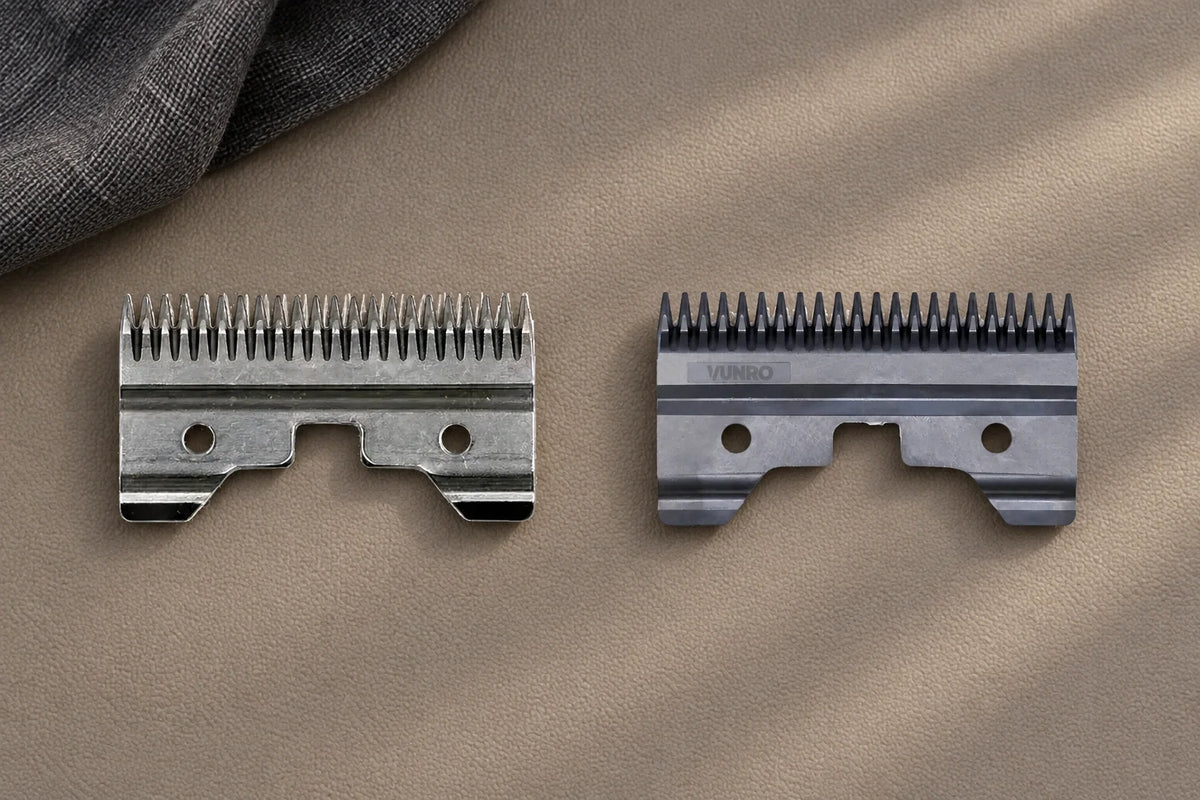
A cutter can resist indentation yet chip when struck. It can conduct heat differently from another material without making the whole blade assembly immune to warming. “Hard”, “tough” and “cool-running” describe different things—and treating them as synonyms makes purchasing decisions less reliable.
For a working groomer, the useful question is which property relates to the problem you are trying to solve.
Separate the three properties
| Property | What it describes | What it does not establish |
|---|---|---|
| Hardness | Resistance to local deformation, commonly assessed through an indentation test. | How a finished cutter will respond to a drop, misalignment or every type of wear. |
| Fracture toughness | Resistance to the extension of a crack under specified loading conditions. | A guarantee that a thin tooth cannot break. |
| Thermal conductivity | How readily heat is conducted through a material. | The temperature reached by a complete moving assembly during a groom. |
NIST's materials resources keep mechanical and thermal properties separate and identify the material, processing and test conditions. That is a useful discipline for reading any tool claim. See the NIST property categories.
Why a material name is not a complete specification
“Ceramic” covers a broad family of materials. So does “steel”. Composition, processing and the geometry of the finished part matter. A property quoted for one laboratory specimen cannot simply be assigned to every cutter sharing its broad material label.
NIST's ceramics database explicitly distinguishes typical values from more thoroughly evaluated data and cautions against treating a typical value as the correct value for an individual material. Read the database's scope and cautions.
That does not make material information useless. It means you should ask a second question: “Was this measured on the product and assembly I am considering, under conditions relevant to my work?” A supplier's useful answer should name the comparison and the outcome, rather than substitute one impressive adjective for another.
Identify the failure before buying its replacement
Keep a short note when a cutter comes out of service. Was there a visible chipped tooth? Did performance deteriorate gradually? Was the assembly dropped? Did the problem appear immediately after a part change? Was the stationary blade also damaged?
These are observations, not a diagnosis of the material. Their value is that they separate a possible impact event from a gradual maintenance or wear problem. If the assembly has visible damage or its condition is uncertain, keep it out of use and obtain a proper inspection.
Changing only the moving cutter will not correct every problem in the stationary blade, retention components or clipper drive. A replacement should follow an assessment of the whole assembly, especially when a supposedly fresh edge produces the same poor result.
Compatibility comes before the material choice
The VUNRO Replacement A5 Cutter in Steel and Replacement A5 Cutter in Ceramic provide material options within their specified applications. Select the exact variant for the blade assembly you own.
A5 is a system description, not permission to interchange every moving cutter. Standard-width, wide, skip-tooth, D-Series and other assemblies need their own confirmed matches. A cutter that looks similar in a photograph is not enough evidence of fit.
For a team using several systems, keep the packaging or an accurate part reference with each spare. Separate storage by the actual assembly and size prevents “the ceramic one” becoming an ambiguous instruction at a busy station.
Build your spare stock around real use
List the blade sizes that work most often, then identify which assemblies can appropriately be refreshed with a confirmed replacement cutter. Keep enough of those specific spares to cover normal turnaround. Where a complete spare blade is more suitable for your process, record that distinction.
This is a better basis for buying several useful parts than ordering one of every material and hoping the collection fits. It also makes later comparisons more meaningful: you can relate service life to an identified part and job, rather than to a drawer of mixed components.
If temperature is driving the decision, read why thermal-camera readings can mislead a blade comparison. A change in surface material can affect the measurement as well as the tool.
Sources and scope
NIST, Property Data Summaries for Advanced Materials and Fracture Toughness / Fracture Energy Data for Ceramics. These explain materials and measurement principles. They do not establish a VUNRO hardness value, service-life percentage or operating-temperature advantage. The purchasing and service records above are practical applications of those distinctions.
Keep learning
More from the Blade Blog

Separate a Dry Surface from a Dry Coat
Read the guide →
Check the Outline in Motion Before Making Another Cut
Read the guide →


