

Keep a Round Foot Round When the Dog Shifts Weight
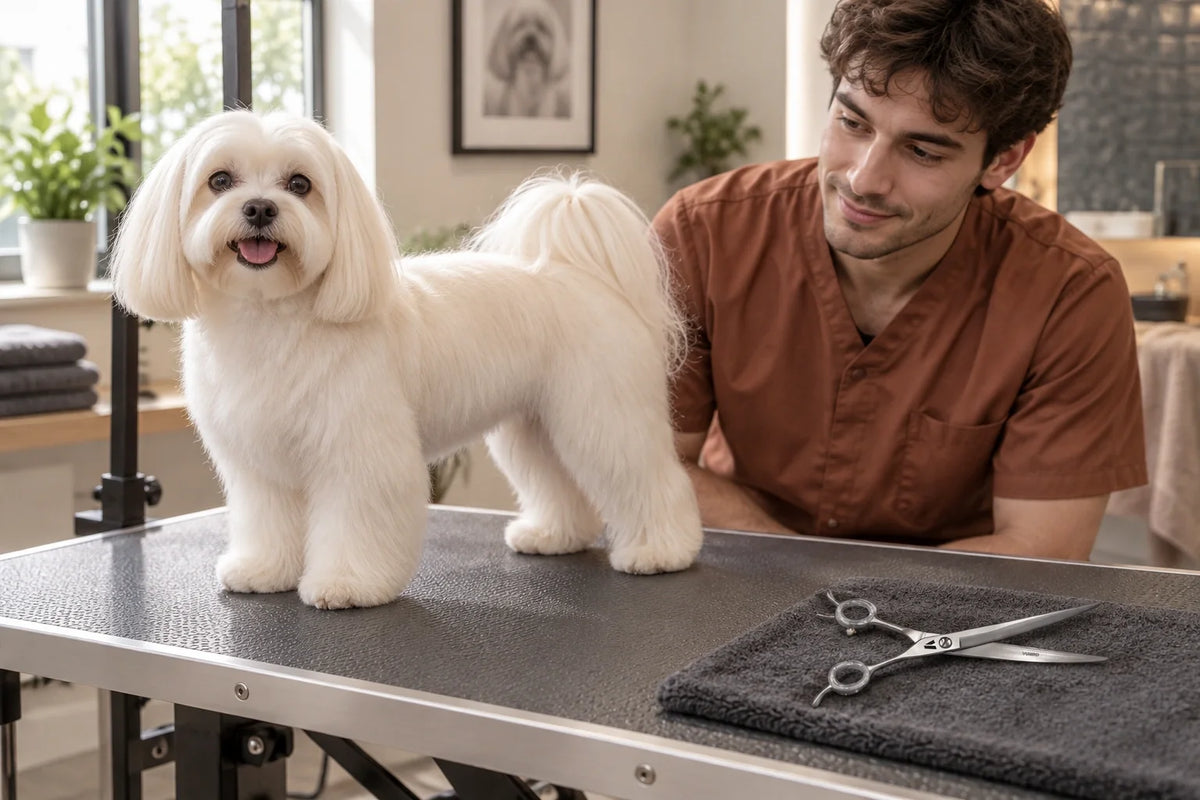
You finish a neat round foot, put the leg down and find a corner you thought you had removed. After another correction, the dog leans forward and a different edge appears. The temptation is to keep following the changing outline with your scissors.
Before doing that, separate the shape of the hair from the position supporting it. A foot assessed while lifted is not presenting its furnishings in the same way as a foot bearing weight.
Choose a repeatable viewing position
Start with the dog standing comfortably on a stable, non-slip surface. Look from a consistent height and direction, with the dog facing naturally forwards where possible. Do not force a painful or reluctant dog into a presentation stance to make your comparison easier.
Research on static weight distribution in 25 healthy small dogs found that the measurement setup affected the result. The authors also noted that small positional changes, including head movement, could contribute to variation. This was a rehabilitation measurement study, not a foot-styling experiment. It is a useful reminder that “standing still” does not mean the loading is identical each time. Read the weight-distribution study.
Separate the perimeter from the underside
The visible foot outline and projecting pad hair are different tasks. Agree the intended style and assess each separately. A round outline should suit the individual dog's foot and leg furnishings; it does not require every foot to become the same-sized sphere.
Keep the underside work within your practical training, with a clear view and comfortable support. Once that work is complete, let the dog return to its natural stance before judging the outer silhouette.
For the access problem under the foot, see Paw-Pad Tidying: Improve Visibility Without Overextending the Leg.
Find the persistent corner
Comb the prepared furnishings gently into the position you intend to assess, then release the lift and allow them to settle. View the front, outer side and transition into the leg. Change your own position rather than repeatedly twisting the foot towards you.
If an edge appears only while the dog is leaning or the leg is held differently, wait for a fair comparison. If the same small projection remains in a comfortable repeatable stance, you have a clearer target.
This distinction prevents a common correction spiral: removing hair for one pose, then removing neighbouring hair to disguise the new short area in another pose.
Use the curve as a guide, not a compulsory shape
The VUNRO 7.5-inch Precision Curved Scissors can help follow an intended contour. Their curve does not establish where the dog's toes, pads or skin are. Maintain a clear cutting view and leave adequate clearance throughout.
Work on the identified projecting hair with controlled closures. Stop cutting whenever the dog changes position. Avoid completing a planned arc by moving open scissors around a shifting foot.
A 5-inch Coarse and Fine Straight Comb provides compact access for checking local furnishings. Use the suitable spacing and manageable sections; it is not a lever for pulling the coat into the shape you want to cut.
Check the whole leg before calling the foot finished
A foot can be tidy in isolation but look disconnected from the column above it. Step back and assess the transition. Preserve enough hair to connect the two shapes, particularly when one area has already been shortened.
If a small irregularity cannot be corrected without making the foot too small, stop and record it for the next appointment. A sensible growth plan is better than repeatedly reducing the surrounding coat.
For a fuller explanation of tool orientation, read Straight or Curved Scissors: Choose the Cutting Plane First. A consistent stance and viewing position make that choice far easier to judge.
Keep learning
More from the Blade Blog

Separate a Dry Surface from a Dry Coat
Read the guide →
Check the Outline in Motion Before Making Another Cut
Read the guide →


